
Your Business Doesn't Need More Documents. It Needs a Defensible Record.

The Haunted House of Business™ | Room 03: The Records Vault
By Katrina Simmons, MLS | Legal Business Consultant & Strategist, Gifted Minds, LLC
You Have the Documents. But Can You Prove What Happened?
Let's talk about something that happens in businesses every day.
A client questions a payment. A contractor disputes the scope of work. A business partner remembers a decision differently. Or someone asks for the paperwork behind a transaction from six months ago.
You know the conversation happened.
You remember the decision.
You're certain someone sent the agreement.
But now everyone is asking the same question:
Where's the paperwork? 👀
Welcome back to The Haunted House of Business™.
This week, we've entered Room 03: The Records Vault, where we're examining the records your business relies on to prove its decisions, obligations, and authority.
Yesterday, in the Records Vault walk-through, we opened three doors: who still has the keys to your accounts, where your approvals actually live, and whether you could find your signed contracts in five minutes.
Today, we're going one level deeper:
What makes a business record reliable enough to back you up when it matters?
Because the answer isn't more documents.
It's a defensible record.
This article provides general educational information and is not legal advice. Contract requirements, record-retention obligations, and evidentiary standards vary by state and circumstance; for advice about your situation, consult a licensed attorney.
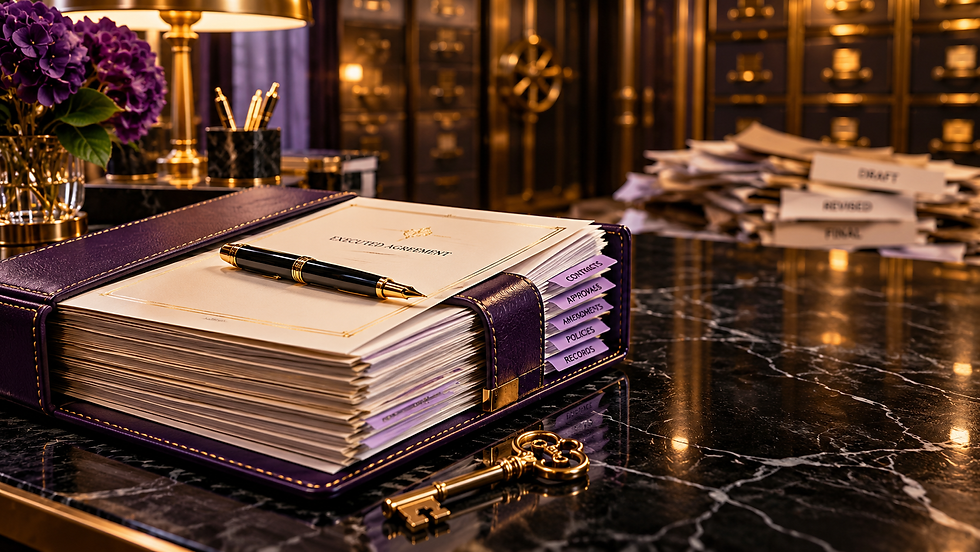
What Is a Defensible Business Record?
A defensible business record is documentation kept in a way that supports its accuracy, authenticity, completeness, and retrieval.
In practical terms, it helps your business answer four critical questions:
What was decided?
Who had the authority to approve it?
What changed afterward?
Which document or decision controls today?
This doesn't mean every document automatically becomes admissible evidence or guarantees an enforceable agreement. Those questions depend on the law and the specific circumstances.
It means your business has a more reliable foundation for explaining and supporting its actions, whether you're facing a payment dispute, a partner conversation, an audit, a funding review, or a sale.
The Five Pillars of a Defensible Business Record
1. Execution: Was the Agreement Actually Finalized?
Every business owner knows how quickly negotiations turn into operations.
You send a proposal. The client says yes. Work begins. Invoices follow.
But was the final agreement ever completed?
Were the signatures obtained? Are the exhibits and attachments included? Did both sides agree to the same terms?
Not every enforceable agreement requires a traditional signature, but not knowing the status of your important contracts creates uncertainty you don't need.
The CEO move: Before the work starts, confirm the final document, the signatures, the attachments, and where the signed copy is saved.
2. Authority: Who Had the Right to Make the Decision?
This is one of the most overlooked areas of business documentation.
It's not enough to show that somebody approved an agreement. You also need to know whether that person had the authority to approve it.
The answer depends on your business entity, your governing documents, and the decision itself. If you have a business partner, your operating agreement may say certain decisions need both of you.
A routine vendor purchase may not need the same approval as admitting a new owner, transferring intellectual property, or taking on significant debt.
The CEO move: Decide who can approve what, and keep a record of the approvals behind your major business decisions.
3. Version Control: Which Document Actually Governs?
Oh, the infamous FINAL-FINAL-REVISED contract. 🤣
We've all seen those file names.
But the problem isn't the name. It's what happens when you're working from one draft, your contractor from another, and your client signed a third.
Good version control separates drafts from signed agreements, tracks amendments, and makes it obvious which document is current. It keeps the history without confusing anyone about what's still in effect.
The CEO move: Use consistent file names, limit who can change your agreements, and keep every amendment with the original agreement it changes.
4. Retention and Retrieval: Can You Find the Record?
Here's a scenario every business owner should think through.
You need a contract signed two years ago.
The person who handled it no longer works with you.
Their inbox is inaccessible.
The shared folder has partial records, and no one knows where the signed version went.
Your business may have had the right documentation at one time, but that doesn't mean it can rely on it today.
And sometimes the record exists, but you can't get to it. If a former contractor set up your shared drive, your e-signature account, or your business email under their own login, your records may be sitting behind a door you don't control.
Retention also isn't simply saving everything forever. How long to keep a record depends on what it is, applicable laws, your contracts, and privacy considerations.
The CEO move: Keep your records in one organized place, decide who can access it, and set a schedule for how long to keep each type of record. Pause routine deletion when a dispute or legal matter means records need to be preserved. And make sure your business, not an individual or a former contractor, owns the accounts where your records live.
5. Operational Consistency: Does Your Business Follow Its Own Records?
This is where documentation becomes how you actually run your business.
Your contract says changes need written approval, but you approved the last three in a DM.
Your policy says sensitive files stay confidential, but they're shared through open links.
In each example, the written process and the actual practice tell different stories.
That gap can create risk even when the original documents were well drafted.
The CEO move: Every so often, compare your contracts and policies against how you actually work. Update whichever one is out of step, and walk your team or VA through the process.

The AI Question: Who Approved That Document?
Now let's talk about the technology increasingly sitting inside your business.
AI can make documentation faster. It can help draft contracts, create policies, summarize meetings, write correspondence, and organize records.
I use AI in my own business. You've even met my AI avatar in this campaign!
But here's what I never want CEOs to confuse:
AI-assisted document creation is not the same as authorized business approval.
A polished AI-generated document can still contain inaccurate statements, conflicting terms, promises you didn't mean to make, or information that should never have been included.
And an AI meeting summary isn't necessarily an accurate or complete record of what your business decided.
That's why you need clear responsibility for reviewing, correcting, approving, and saving documents created with AI's help: a final approved version, a record of human review on the important ones, and protection for confidential information.
You don't need to save every AI prompt or draft. You need a practical policy that fits your actual legal, contractual, and business requirements. I keep a running list of my own prompts in a document I have stored in my document library. Not just saved chat history in an AI platform.
The CEO move: Decide which AI-assisted documents need review, who approves them, how you mark the final version, and what you keep.
Your Records Vault Self-Assessment
Here's your assignment this week.
Choose one significant business decision from the last 12 months: a vendor agreement, a contractor arrangement, an ownership decision, a major purchase, or a change in your service terms.
Then ask:
Can I identify the agreement or decision record that controls?
Can I show who approved it?
Can I find the amendments or changes?
Did my business actually follow what the documents required?
Can I pull up the supporting records without relying on one person's memory or personal inbox?
If your answers reveal gaps, you've found an opportunity to strengthen your business infrastructure.
Want the 10-minute version? The free Keys & Records Check walks you through 14 questions and gives you a vault score.
The Bottom Line: Protect the Decision, Not Just the Document
Business documentation isn't just administrative work.
It's how your business establishes accountability, protects its relationships, and keeps what it knows when people come and go.
You don't need more paperwork for the sake of paperwork.
You need records that reliably reflect what your business decided, approved, changed, and implemented.
And if you aren't sure where your gaps begin, that's a conversation worth having before a dispute forces it.
🔐 Want Someone to Open the Vault With You?

After the inventory, book a CEO Legal First Response Session™ to review the results and identify the highest-priority gaps. We review your inventory together, find what’s missing, and decide what needs attention first. If implementation turns out to be your next move, your session investment goes with you.
If implementation turns out to be your next move, your session investment goes with you.
When the business gets challenged, the record becomes the witness.
Watch the Room 03: The Records Vault video walk-through: https://www.facebook.com/giftedmindsllc
Next week, we step into the final room: the Website Hall of Mirrors. Does your website reflect your actual business, or an outdated version of it? See you there. 💜
Protect Your Gifts. Legalize Your Legacy.™
Gifted Minds, LLC is a legal business consultancy, not a law firm. This article is for general educational and business-information purposes only and is not legal advice. AI-related laws, regulations, platform terms, and guidance continue to evolve. For advice about your specific situation, consult a licensed attorney.



Comments